Build data platforms in days,
not weeks.
Wire is the delivery framework that turns Claude Code and Gemini CLI into a senior analytics engineer that already knows your conventions. Every artifact — from requirements to LookML — generated, validated and reviewed against the same playbook we’ve refined over 20+ years.




The Data Team's Dilemma: Speed vs. Trust
Traditional analytics delivery is broken. Business leaders want answers yesterday, but the process is slow and fraught with risk.
Your Challenges:
-
Moving too fast leads to inconsistent metrics, broken dashboards, and a gradual erosion of trust from the very stakeholders you're trying to serve.
-
Moving too slowly means missed opportunities, a frustrated business, and a data team that is perpetually seen as a bottleneck, not a strategic partner.
-
AI is not a magic bullet, used incorrectly, it just creates higher volumes of low-quality work. Used strategically, it can transform your team's entire operating model.
Our Solution: AI-Augmented Process, Human-Led Judgment
Our approach uses AI to automate repetitive tasks and accelerate feedback loops, freeing your team to focus on what matters most: complex business logic and stakeholder collaboration.
Proof in Practice:
See how we partnered with Barton Peveril College to deliver an AI-accelerated MVP analytics platform in just 15 working days, pioneering a new approach for UK education.
Read More → Barton Peveril
AI code generation gets the SQL right.
It gets the methodology wrong.
Drop an AI into a dbt project with no scaffolding and you get models that compile, then naming chaos, missing tests, drifting grain, all the things a senior analytics engineer wouldn’t miss.
Improvisation at every step
The model knows the conventions. It just isn’t held to them. The result is technically valid SQL that, over 15 models, drifts in ways that erode the value proposition entirely.
- Inconsistent naming across
stg_,int_,wh_layers - Missing surrogate-key patterns and grain management
- FK relationship tests skipped on half the models
- Requirements untraceable to warehouse columns
- Each engagement is a one-off with no compounding
Generation, constrained.
Each command reads its workflow specification before generating. The spec dictates upstream inputs, naming, structure, validation checks, and how state is updated. Every artifact looks like the team has been on the project for months.
- Encoded conventions for dbt, LookML, pipelines and docs
- Automatic prerequisite enforcement between artifacts
- Validation is mechanical: pass / fail with named failures
- Research findings persist across sessions and releases
- Every engagement compounds onto the same framework
Ten shapes of engagement.
One framework.
Discovery to scope it. Ten delivery types for everything from a one-week dbt sprint to a full platform build. Agentic Commerce for AI-powered storefronts. Pick the type; the framework instantiates the right artifact queue.
Discovery
Shape Up planning: problem → pitch → release brief → sprint plan.
Full Platform
SOW → production dashboards + trained users. End-to-end.
Dashboard-First
Interactive mocks drive the data model; seed data enables immediate dbt.
Pipeline + dbt
New pipeline plus dbt transformation layer; BI out of scope.
dbt Development
Analytics engineering on existing pipeline infrastructure.
Dashboard Extension
New dashboards on top of an existing, populated semantic layer.
Enablement
Training and documentation for an existing platform.
Agentic Commerce
AI-powered ecommerce: Lovable + 9 AI features (search, try-on, assistant).
Data Migration
Lift, validate and cut over legacy warehouses, pipelines and dashboards with rollback coverage.
Platform Health Check
Rapid audit of dbt, pipelines and dashboards with a prioritised backlog of fixes and quick wins.
How AI-Augmented Delivery Works
Our methodology embeds AI into every stage of the analytics lifecycle, while keeping your expert team in complete control.
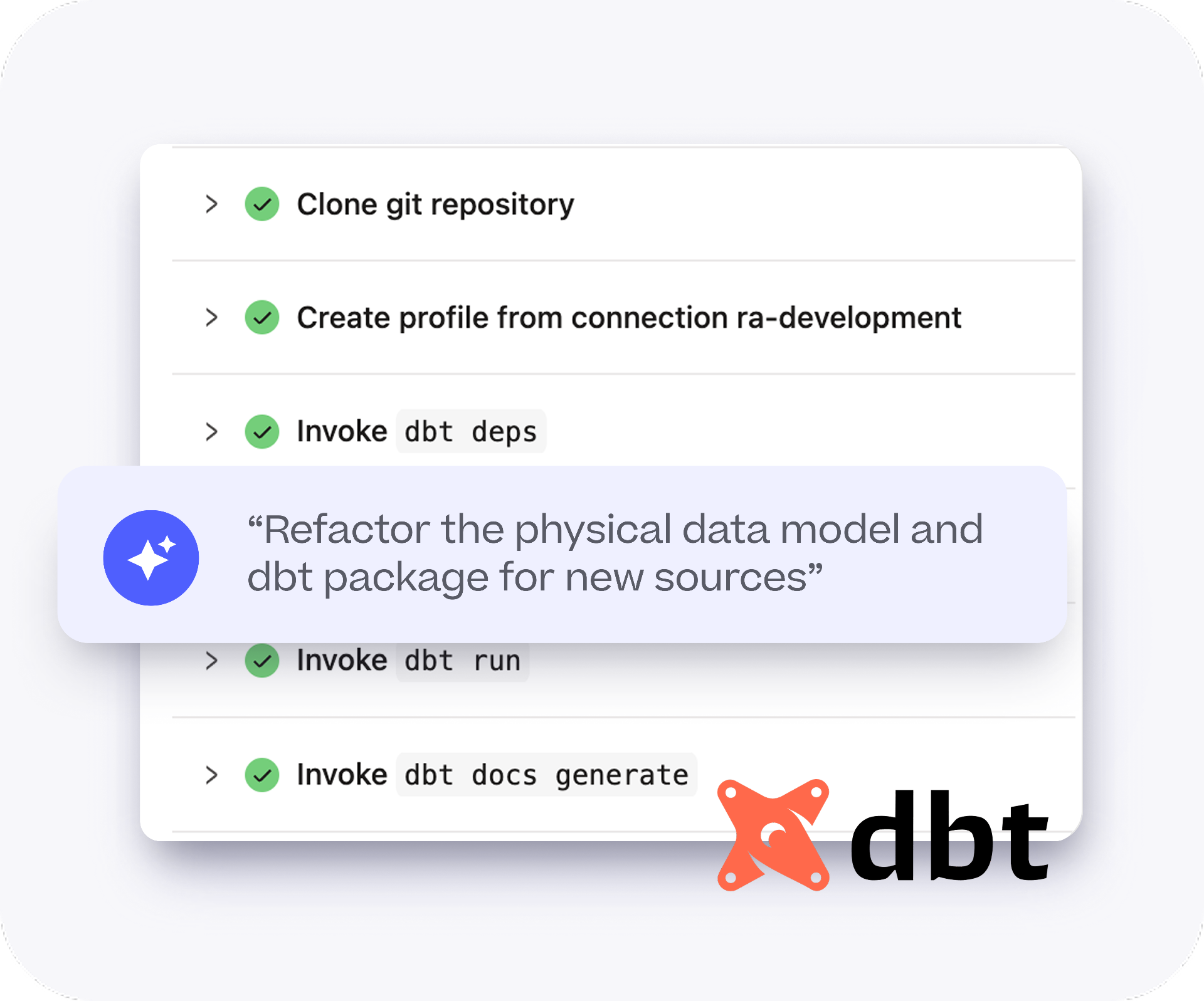
Accelerated Prototyping
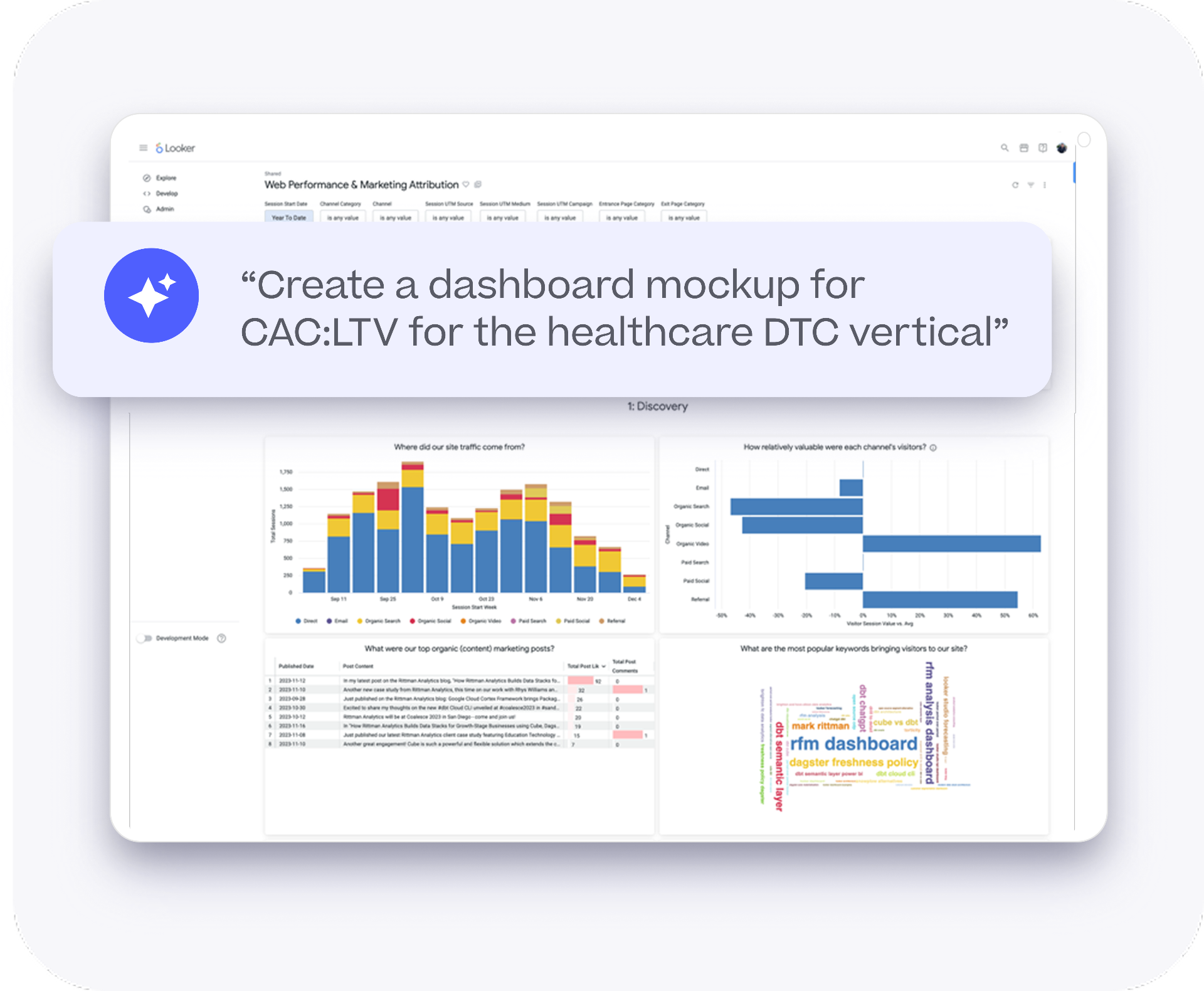
Use AI to generate initial data models and dashboard mockups directly from your requirements, making stakeholder conversations concrete and productive from day one.
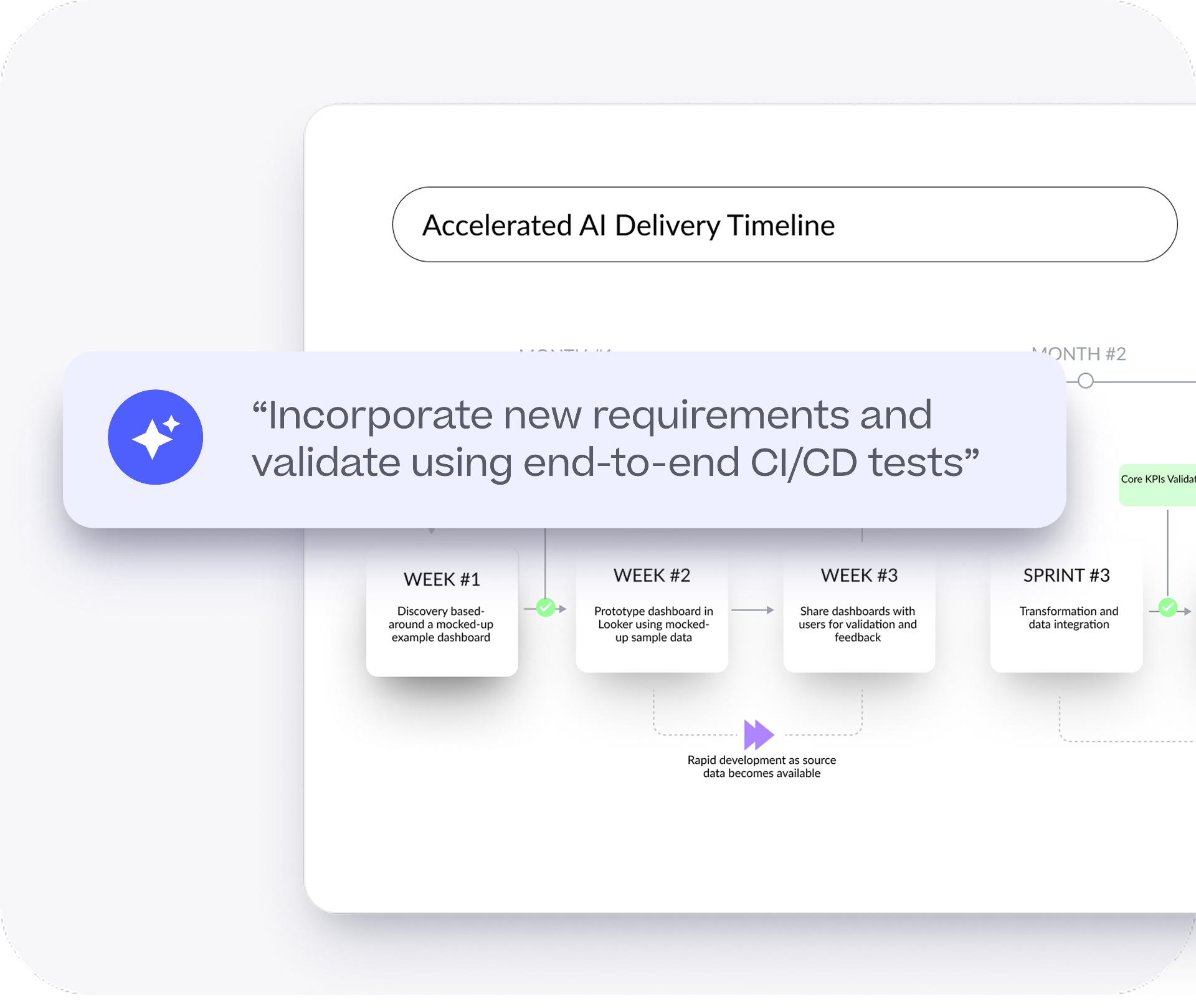
Governance at Speed
Ensure every AI-generated asset passes through clear, human-led review gates. We maintain 100% explainability, semantic clarity, and trust in your final data products.
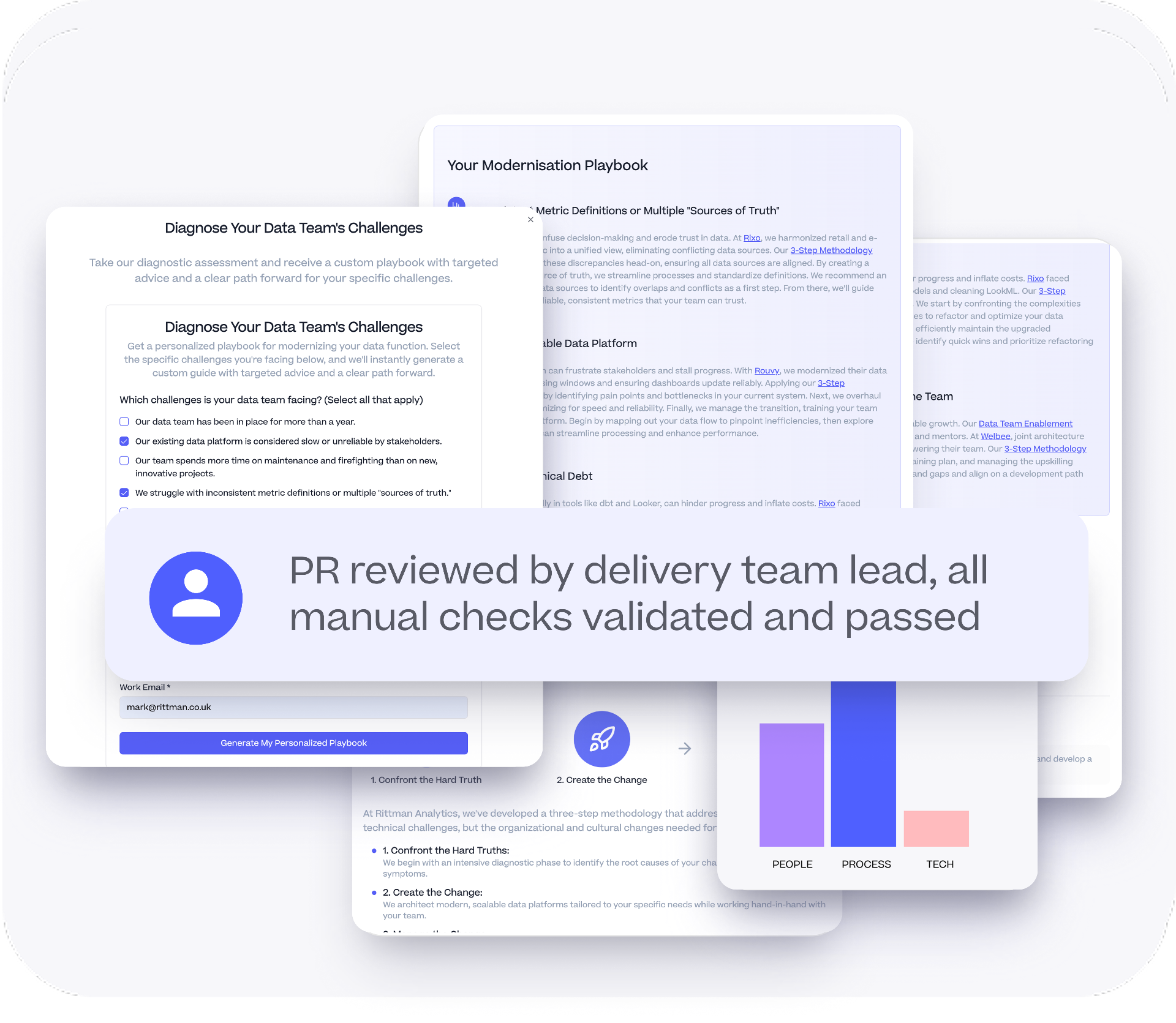
Faster Iteration
Instantly generate boilerplate code, documentation, and tests, allowing your engineers to focus on solving unique business problems, not on repetitive, low-value tasks.
Deeper Collaboration
Free your team from waiting on slow builds and manual processes. More time is spent with stakeholders validating insights and less time debugging pipelines.
Three gates, every artifact.
Every artifact follows the same three-gate pattern. Substitute <artifact> with requirements, conceptual_model, dbt, anything in the queue. The next gate doesn’t fire until the previous one passes, phase discipline is structural, not a checklist someone might skip.
Generate
AI reads the spec and upstream inputs, produces the artifact. Files land in the release folder.
Validate
Automated checks against conventions. PASS or FAIL, with the specific failures listed.
Review
You or the stakeholder approves. Status moves to approved or changes_requested.
Each gate updates status.md and appends to execution_log.md. Nothing happens off the books, so a new team member picks up an engagement and is productive within an hour.
Wire, right inside your editor.
The Wire VS Code extension surfaces every /wire:* command, every artifact gate state, and the running execution log in the editor you already live in. It shares state with the CLI, so you can switch between them mid-engagement without a beat.
Status sidebar
Every artifact’s gate state visible in a dedicated side-bar pane, one click to open the file.
Command palette
⌘⇧P → type “Wire”. All 67 commands one keystroke away, with the release IDs auto-completed.
Inline terminal output
Generate, validate and review run inside the editor terminal, with syntax-highlighted validation reports.
Live status.md
The release’s status.md updates in real time as you run commands. Diff-friendly, git-friendly, review-friendly.
Search “Wire Framework” in the VS Code Marketplace, or run code --install-extension rittmananalytics.wire. Requires VS Code 1.98+ and Claude Code.
Hand it the SOW. Walk away.
For standard engagement shapes, Autopilot takes a Statement of Work and runs the entire lifecycle, discovery sprint, then every downstream delivery release the discovery identifies, autonomously.
- Eight context questions upfront, client name, repo mode, tracker, document store. No release-type guessing.
- Self-validates and self-approves internal artifacts, with up-to-three retries on validation and self-review.
- Safety gates before any phase that touches external systems, pipeline activation, data refactor, deployment.
- Resumable from checkpoint, interruptions cost minutes, not a re-run.
autopilot · acme-platform.sow.pdf
Live pastoral analytics, end-to-end, in 8 working days.
Barton Peveril Sixth Form College needed a live pastoral-risk dashboard on top of ProSolution MIS and Focus, with safeguarding-grade data handling and same-week training for SPAs and pastoral leads.
One full_platform release. 15 artifacts. SOW signed on Monday; dashboards live and end-users trained by the following Wednesday.
Sits inside the tools your team already uses.
Wire ships as a plugin for Claude Code and an extension for Gemini CLI. State is plain markdown in git. Integrations are MCP-native — one command to authenticate, then state syncs automatically.
Pipeline design + cost analysis. Connectors verified before generate; assets-first Dagster.
Bidirectional sync from status.md to your tracker. Fail-graceful — never blocks delivery.
Every approved artifact auto-publishes to your client’s space. Discovery docs reviewable in their tooling.
utils-meeting-context pulls transcripts into the engagement before every call.
Start your next engagement on Wire.
Book a 30-minute walk-through and see Wire run end-to-end on one of your SOWs, or one of ours. Take the recording away whether or not we work together.
What you’ll see
- SOW → live dbt + LookML in under 30 minutes via Autopilot.
- The exact validation rules a Rittman senior would apply.
- How the same playbook runs across BigQuery and Snowflake.
- How to roll Wire into your own delivery team.